
November 8 marks 6 years after demonetisation. A K Bhattacharya reveals how the prime minister and the RBI worked together for months before Modi's 8 pm speech. A riveting excerpt from The Rise Of Goliath: Twelve Disruptions That Changed India.

A special National Investigation Agency court in Mumbai on Wednesday convicted six persons for possessing and circulating Fake Indian Currency Notes in May 2009.

No form or requisition slip is required for exchange of Rs 2,000 notes up to a limit of Rs 20,000 at a time as part of exercise to withdraw high-value currency notes from circulation. RBI on Friday in a surprise move announced withdrawal of Rs 2,000 currency notes from circulation but gave public time till September 30 to either deposit such notes in accounts or exchange them at banks. Unlike the November 2016 shock of demonetisation, when old Rs 500 and Rs 1,000 notes were invalidated overnight, the Rs 2,000 notes will continue to be a legal tender.

The interchange fee -- paid by the card-issuing bank when a customer swipes at another bank's ATM, including at white-label ATMs -- may be raised to Rs 20 to Rs 23.

Debroy, in an interview with India TV news anchor Karan Thapar, said there would be no shortage of currency notes and the demonetisation exercise was justified -- it would be a deterrent for future generations.

The government on Tuesday night announced that Rs 500 and Rs 1,000 will be no longer legal tender after November 8, midnight. Here are the details you need know
Dinesh Tati (23), resident of Palnar village in Gangaloor police station limits, was held on Friday from a tractor showroom in Bijapur town, Additional Superintendent of Police Chandrakant Gavarna said.

A look at the current contenders International Bank Note Society's Banknote of the Year
The Reserve Bank of India on Thursday said banknotes in circulation witnessed higher than average increase during 2020-21, on account of precautionary holding of cash by people due to the COVID-19 pandemic, and its prolonged continuance. The value and volume of banknotes in circulation increased by 16.8 per cent and 7.2 per cent, respectively, during 2020-21, as against an increase of 14.7 per cent and 6.6 per cent, respectively, witnessed during 2019-20, said the RBI annual report. In value terms, the share of Rs 500 and Rs 2,000 banknotes together accounted for 85.7 per cent of the total value of banknotes in circulation as on March 31, 2021, as against 83.4 per cent as on March 31, 2020.

On November 8, 2016, Prime Minister Modi had announced the decision to withdraw Rs 500 and Rs 1,000 denomination notes with the ultimate aim of reducing corruption and black money in the economy.

Uncertainties on account of COVID-19 pandemic have increased the demand for currency notes not only in India but across the globe, official sources said, dismissing the criticism that demonetisation has failed to reduce cash in the economy. Government sources said that growth of the digital payments system post-demonetisation will ultimately curb the dependence on cash. Official data points out a jump in digital payments through different modes, including plastic cards, net banking and Unified Payments Interface (UPI).

Even though the NIA claims that more than 90 per cent of cases charge-sheeted have ended in conviction, the figure is likely misleading. To date, very few cases investigated by the NIA have resulted in a completed trial, points out former CBI joint director Navneet Rajan Wasan.


Delhi Chief Minister Arvind Kejriwal on Wednesday appealed to Prime Minister Narendra Modi to have photos of Lord Ganesh and Goddess Lakshmi on currency notes.

The hour-long episodes lurch from adrenaline-pumping to yawn-inducing, observes Deepa Gahlot.

There will be a lot to repair and rejuvenate -- if that opportunity even presents itself, warns Rathin Roy.

The printing of Rs 2000 notes has been substantially reduced. It has been decided to limit the printing of 2000 currency notes to minimum. This is nothing new, a FinMin official said.
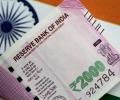
The number of Rs 2,000 currency notes in circulation has come down from 33,632 lakh pieces at end-March 2018 to 32,910 lakh pieces at end-March 2019 and further to 27,398 lakh pieces at end-March 2020.

The Central Board of Direct Taxes is set to rationalise I-T rules.

The Central Bureau of Investigation has taken over the investigation of four distinct cases from the Assam police, all connected with the death of the state police sub-inspector Junmoni Rabha last month in a suspected road accident, according to officials.

Abdul Karim Tunda, the Lashkar-e-Tayiba's bomb-maker, has revealed the terrorist organisation's salary structure and generous perks. Vicky Nanjappa reports.

'It has taken 7-and-a-half years for this government to understand the fundamentals of economics.' 'If the prime minister wants to leave an imprint, he has to see to it that this succeeds.'

Rs 14.5 lakh crore of Rs 500 and Rs 1,000 notes have been deposited as of 30/12.

As we find ourselves batting on a sticky wicket, every ball needs to be played on merit, says stockmarket wizard Motilal Oswal.

The self-styled Sikh preacher continued to be on the run for a week now following the police crackdown against him and his Waris Punjab De outfit.

The currency with the public is 10.3 per cent higher than it was in the week preceding November 8, 2016 - from Rs17.97 trillion to Rs18.76 trillion.

For the first time, the value of card and mobile payments of Rs 10.57 trillion was more than ATM withdrawals of Rs 9.12 trillion in Q4 of fiscal 2019-20. In the months of lockdown, the gap may have widened further, but cash could be back in vogue when the situation normalises.
Liquidity in the banking system has slipped into a deficit for the first time in three weeks, prompting banks to borrow the largest quantum of funds from the Reserve Bank of India (RBI) in around a month and a half. The key catalyst for the sudden tightening in liquidity was due to outflows on account of advance tax payments, which occur towards the end of a quarter. Analysts also cited other factors such as a currency leakage and possible interventions by the RBI in the foreign exchange market, which contributed to the tighter liquidity conditions.

According to officials, seven employees of the Yojna Bhawan having access to the basement have been detained for questioning.
It is a classic case of extremes: The worst contraction in GDP along with the highest-ever levels of cash in the economy; and a severe dent in consumption together with strong growth in bank deposits and digital payments.
'Once the Hon'ble Supreme Court has declared the law, we are obliged to accept it. However, it is necessary to point out that the majority has not upheld the wisdom of the decision; nor has the majority concluded that the stated objectives were achieved,' the senior Congress leader said in a tweet.

Adequate currency in circulation, temporary shortage to be tackled quickly, says FM

RBI has maintained the stock of currency through advance as well as current printing level

RBI has printed 16,957 million pieces of Rs 500 notes and 3,654 million pieces of Rs 2,000 notes as on December 8.

The hoarding of cash accentuated from the very start of 2020, when the coronavirus pandemic started taking hold the world over, and fear of the pandemic prodded people to remain liquid for emergency use.

Currently the currency in stock is about Rs 2 lakh crore and the reserves are adequate to meet any unusual spurt in demand

Only Rs 10,720 crore of the junked currency notes did not return to the banking system, rest 99.9 per cent was deposited raising question mark over the government's effort of curbing black money through the demonetisation.

Rapid strides in digital payments notwithstanding, the Indian economy will likely remain cash-dependent for many years to come, at least that's what the automated teller machine makers and cash logistics companies are betting on. After growing at over 20 per cent for most of 2020, currency in circulation growth fell to 8.5 per cent as of October 29 this year, shows data from the Reserve Bank of India (RBI). The reason for the steep rise in currency last year was the uncertainties related to the Coronavirus (Covid-19) pandemic, where people preferred to hoard cash to meet exigencies.

I kept insisting that Rs 100 notes were in short supply and there was an urgent need to augment the supply of 100 rupee notes while also rapidly bringing into circulation the proposed new Rs 500 notes. But this was easier said than done because all the note printing machines of the RBI were programmed for printing Rs 2,000 notes and required at least three weeks before the machines could print the new Rs 500 currency notes. The availability of currency paper posed another major bottleneck, and it had to be imported. It was decided to immediately start printing the Rs 500 notes. It was only when the supply of the new Rs 500 notes started improving and the process of change of cassettes at the ATMs gathered momentum that the situation began limping back to normal. A fascinating excerpt from former SBI chairman Rajnish Kumar's The Custodian of Trust: A Banker's Memoir, five years after demonetisation, November 8.

This mean that just Rs 10,720 crore of the junked currency did not return to the banking system.
